 Law Office of Jason Ostendorf LLC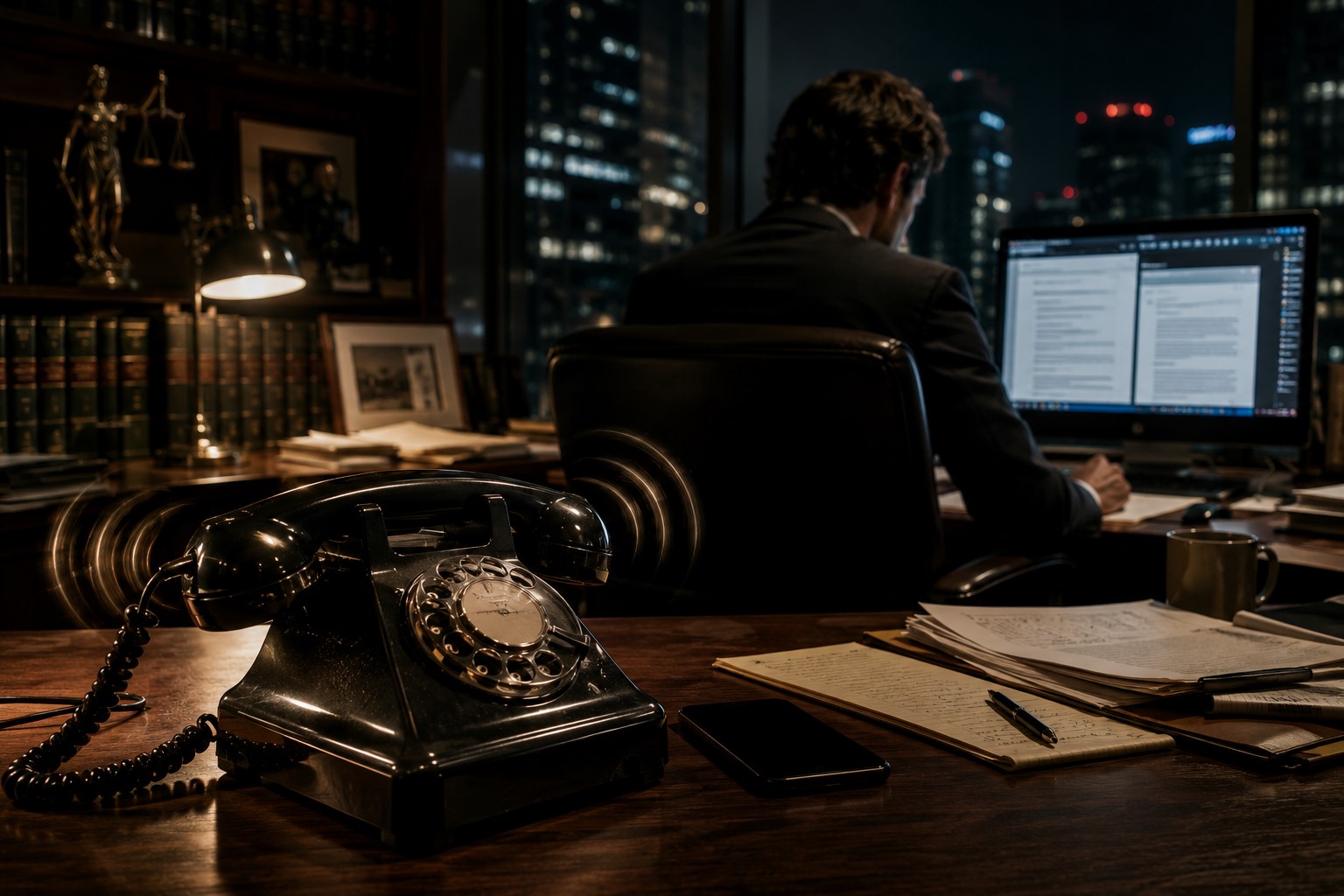
It is 2026.
We carry computers in our pockets. We transmit documents across the planet in seconds. Lawyers can search thousands of judicial opinions without leaving their desks. Artificial intelligence can analyze information, summarize documents, and assist with complex research faster than most humans could have imagined a generation ago.
And yet, somehow, grown adults still believe the optimal way to communicate important information is to make another human being stop whatever he or she is doing, pick up a device, and listen to them speak in real time.
Why?
Seriously.
Why are some people still doing this?
The telephone may be one of the most inefficient technologies still stubbornly embedded in professional life. And in the practice of law—where precision, documentation, concentration, and careful thought actually matter—the continued obsession with telephone calls makes even less sense.
There are exceptions, of course. Emergencies exist. Certain negotiations benefit from real-time conversation. Some unusually sensitive discussions are better handled by voice.
But as the default method of communication between lawyers and clients?
It’s 2026. We can do better.
The Telephone Is an Interruption Machine
A telephone call requires synchronous communication. Two people must stop what they are doing and communicate at precisely the same moment.
Email and text are asynchronous. The sender communicates when convenient. The recipient reads the message when appropriate, considers it, researches anything requiring research, and responds when prepared to provide a meaningful answer.
For lawyers, that distinction matters.
Consider what your lawyer might be doing when the phone rings.
Perhaps your lawyer is drafting an appellate brief. Perhaps reviewing a thousand-page record. Perhaps preparing for oral argument. Perhaps analyzing a difficult question of law that requires twenty uninterrupted minutes of concentration to work through properly.
Then… the phone rings.
An unexpected telephone call carries an implicit demand: Whatever you are doing right now, stop. I would like your attention instead.
That may sound harsh. Most clients certainly do not consciously intend it that way. But functionally, that is precisely what a telephone call does.
Good lawyers often work extraordinarily long hours. Some routinely work sixty, seventy, eighty, or even ninety hours in a week. The scarce resource in a busy legal practice is not merely time. It is uninterrupted attention.
A client should want a lawyer who protects that resource.
You do not want your appellate lawyer abandoning a complicated constitutional argument every fifteen minutes because someone else decided it was a good time to chat.
And when you have a complicated question of your own, you should not necessarily want an immediate answer either.
You should want the right answer, not a quick, off-the-cuff reply.
“It’s Easier to Explain by Phone”
This is perhaps the most common defense of the telephone.
“It’s easier to explain by phone.”
Maybe.
But easier for whom?
A caller can unload ten minutes of information without organizing any of it. The lawyer must listen, identify what matters, separate relevant facts from irrelevant ones, take notes, remember details, ask questions, and eventually reconstruct the conversation.
Writing imposes discipline.
When you sit down to explain something in an email, you are forced to decide what happened, when it happened, who was involved, and why you believe it matters.
That process is not an inconvenience. It is useful.
Writing clarifies thought. Indeed, if an issue cannot be explained coherently in writing, there is at least a reasonable possibility that the person explaining it has not yet thought about it coherently.
The same applies to lawyers.
A lawyer who understands a legal issue well enough to advise a client should ordinarily be capable of explaining that advice clearly in writing. If the lawyer cannot, the problem may not be the medium.
Lawyers Should Be Terrified of Undocumented Conversations
There is another problem with telephone calls that should concern both lawyers and clients.
They disappear.
Two people speak. The conversation ends. Unless someone took detailed notes or recorded the conversation where legally permissible, what remains is memory.
And human memory is terrible.
Not necessarily dishonest. Not malicious. Just terrible.
People remember conversations differently. Details disappear. Qualifications vanish. Subsequent events influence our recollection of what was said before those events occurred.
A lawyer says, “You have a strong argument, but there are significant risks.” Months later, after an unfavorable result, the client remembers: “My lawyer told me I had a strong case.”
A lawyer says, “That is an option we can consider.” The client remembers: “My lawyer told me to do it.”
A client says, “I never agreed to that.” The lawyer remembers the conversation differently. Then comes one of the most dangerous sentences in professional life:
“That’s not what you told me.”
Written communication does not eliminate disagreement. But it creates something enormously valuable: a contemporaneous record.
- The client can reread the advice.
- The lawyer can reread the instructions.
- Dates can be confirmed.
- Questions can be answered point by point.
- Misunderstandings can be identified before they become disasters.
Written communication protects the lawyer, certainly. But it also protects the client.
Welcome to the Voicemail Graveyard
And then there is voicemail…
Voicemail may be the most inexplicably persistent communication technology in modern professional life. Someone calls while you are unavailable. They leave a three-minute message. Now you must stop working, retrieve the message, listen to it linearly, perhaps replay portions of it, take notes, and then communicate back through another medium.
Compare that with an email.
An email can be:
- scanned in seconds;
- searched months or years later;
- forwarded to someone who needs the information;
- quoted precisely;
- organized into a client file; and
- answered point by point.
A voicemail can be… listened to.
How much important information has been delayed because it was buried in a voicemail? How many lawyers have seen the notification, thought, “I’ll listen to that when I have a minute,” and then been pulled into something else?
How many clients believe they have efficiently communicated something important when, in reality, they have selected the medium most likely to make the information inconvenient to process?
If your message actually matters, why would you want to make it harder to retrieve?
The Client Who Insists on Phone Calls May Be Telling You Something
To be clear, preferring telephone conversations does not make someone a bad client.
But, insisting upon them might be another matter.
A prospective client who refuses to communicate in writing may be revealing something about the attorney-client relationship before it even begins:
- Perhaps the person expects immediate access to the lawyer.
- Perhaps professional boundaries are going to be a problem.
- Perhaps the person wants to consume large quantities of attorney time without recognizing that the lawyer has other clients.
- Perhaps the person does not like committing statements to writing.
- Or perhaps the person is primarily seeking emotional reassurance rather than legal analysis.
These are all red flags—especially the last one. And they are certainly things a lawyer should notice.
A client who cannot tolerate giving a lawyer time to think may not actually want legal advice. They may want an audience.
And lawyers should be particularly cautious about the expectation that they must drop whatever they are doing whenever a client wants to talk.
A lawyer working a ninety-hour week does not have ninety interchangeable hours available for interruptions. Legal work frequently requires sustained concentration. Every interruption has a cognitive cost, and the lawyer must eventually return to the abandoned task and reconstruct the mental context that existed before the phone rang.
The irony is that the client demanding immediate access may actually be making the lawyer less effective—for that client (and everyone else).
Lawyers Should Ask Themselves Why They Still Want the Phone
Clients are not the only ones who should reconsider their habits.
Lawyers who insist upon conducting substantive legal communications primarily by telephone should ask themselves why.
Sometimes there is a legitimate answer. But sometimes the telephone provides something writing does not: ambiguity.
Writing forces precision. It forces the lawyer to articulate the analysis. It exposes fuzzy thinking. It preserves qualifications. It prevents both sides from quietly revising history later.
A lawyer who understands the law should generally be able to explain it in writing. A lawyer who has confidence in the advice being given should generally have no objection to creating a record of that advice.
That does not mean every passing thought needs to become a formal memorandum. Text messages and emails can be perfectly conversational.
But important advice should survive longer than the sound waves that carried it.
The Telephone Is Really About Control
There may be a deeper reason people remain attached to telephone calls. And for an attorney who knows what they’re doing—and what effective representation requires—this can be a huge red flag.
Control.
The telephone provides something psychologically powerful: immediate access to another person’s attention.
Send an email and you surrender control. The recipient decides when to read it. The recipient decides when to think about it. The recipient decides when to respond.
Make a telephone call and you attempt to collapse all three decisions into a single moment: Now.
A client who needs this places a higher priority on feeling in control than in receiving proper direction and guidance. And that is a problem.
This does not make every person who places a telephone call selfish. Obviously.
But it reveals something interesting about the psychology of communication. For much of human history, immediate access to another person across great distances was impossible. The telephone made it miraculous. But today, immediate access is everywhere. Perhaps the greater luxury now is the opposite.
The ability to be unreachable for a moment. The ability to concentrate. The ability to consider a question before answering it.
The ability to think.
Sometimes, Yes, Pick Up the Phone
None of this means telephone conversations should be abolished.
Emergencies happen. Negotiations sometimes move faster through direct conversation. Sometimes tone matters enough to justify sacrificing the benefits of writing.
Fine.
But the telephone should increasingly be the exception requiring a reason, not the professional default inherited from an era when fax machines were considered cutting-edge technology…
For routine client communication, legal advice, factual updates, instructions, and substantive discussions, writing simply offers extraordinary advantages. And perhaps most importantly, it gives lawyers and clients something increasingly rare in modern life: Time to think.
Stop Calling. Start Thinking.
The practice of law should value precision over immediacy. Documentation over recollection. Thought over interruption.
Substance over the appearance of accessibility.
Clients deserve lawyers who think carefully before answering their questions. Lawyers deserve clients who respect the conditions necessary for careful thought.
And everyone deserves to stop listening to voicemail.
It’s 2026.
Image Credit: OpenAI DALL·E.