 Law Office of Jason Ostendorf LLC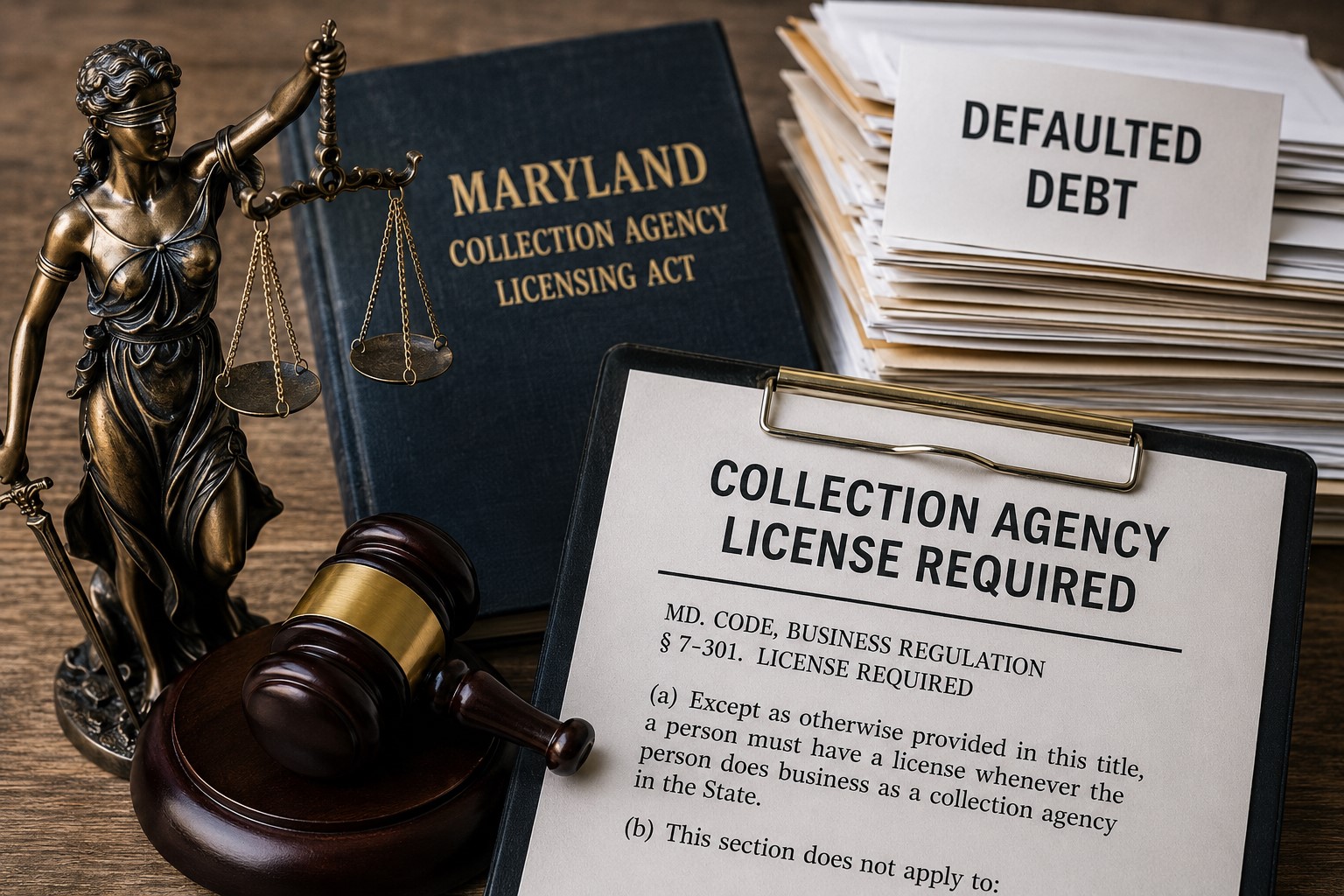
Maryland’s debt collection statutes contain a trap that many debt buyers either overlooked or hoped courts would overlook for them.
The problem is deceptively simple.
If a company purchases consumer debt that was already in default when acquired, and then attempts to collect that debt in Maryland, the company generally must be licensed as a collection agency under the Maryland Collection Agency Licensing Act (“MCALA”).
That statutory requirement produced years of litigation involving debt buyers, collection lawsuits, default judgments, and eventually one of Maryland’s most significant consumer debt collection decisions: LVNV Funding LLC v. Finch, 463 Md. 586 (2019).
Although Finch is now well-known among Maryland consumer attorneys and creditors’ rights lawyers, the case remains important because it clarified several critical issues:
- when a debt buyer qualifies as a “collection agency” under Maryland law;
- whether an unlicensed debt buyer acts unlawfully by filing collection lawsuits;
- whether judgments obtained by unlicensed debt buyers are void; and
- whether consumers may recover damages under Maryland’s consumer protection statutes.
The Statute: Maryland Business Regulation § 7-301
The starting point is Maryland Business Regulation § 7-301(a), which provides:
“Except as otherwise provided in this title, a person must have a license whenever the person does business as a collection agency in the State.”
That language sounds straightforward enough. The dispute in Finch centered not on whether a license was required for collection agencies generally, but whether companies like LVNV qualified as collection agencies at all.
LVNV argued that it was merely a “passive” debt buyer. According to LVNV, it owned debt but outsourced collection activity to affiliated entities and therefore did not directly engage in debt collection activity requiring licensure.
The Maryland Supreme Court rejected that argument.
Debt Buyers and the “Passive Owner” Argument
The Court examined the structure of LVNV and its affiliated entities in detail. Although LVNV claimed to have no employees and to merely hold debt, the evidence showed a far more integrated operation involving affiliated collection entities, litigation activity, and coordinated debt collection efforts.
Most importantly, the Court focused on the statutory definition of “collection agency,” which includes entities collecting consumer claims they own if the claims were already in default when acquired.
The legislative history mattered heavily here.
The Court explained that Maryland amended MCALA specifically to close what lawmakers viewed as a loophole in the debt-buying industry. Prior to the amendment, debt buyers frequently argued that because they technically owned the debt, they were not collecting “for another” and therefore did not require collection agency licenses.
The General Assembly changed the statute to address precisely that situation. As the Court explained:
“The testimony given to the Legislature in support of that bill was that the intent of the amendment was to ‘close a loophole’ and require that buyers of consumer debt in default be licensed before engaging in collection efforts.”
In short, Maryland saw the debt-buying industry evolving and responded directly.
Filing Lawsuits Without a License
The Court ultimately held that LVNV was required to obtain a collection agency license and acted unlawfully when it pursued collection activity before becoming licensed in 2010.
That conclusion had significant downstream consequences because Maryland’s consumer protection statutes prohibit debt collectors from attempting to enforce rights that do not legally exist.
The Maryland Consumer Debt Collection Act (“MCDCA”) provides that a collector may not:
“Claim, attempt, or threaten to enforce a right with knowledge that the right does not exist.”
The Court concluded that an unlicensed debt buyer attempting to collect consumer debt through litigation was attempting to enforce a right that, for it, did not legally exist.
That holding opened the door to statutory damages claims under Maryland law.
Were the Judgments Void?
One of the most closely watched portions of Finch involved whether judgments obtained by unlicensed debt buyers were automatically void.
The Court of Special Appeals had previously concluded that the judgments were void and therefore subject to collateral attack years later. The Maryland Supreme Court disagreed.
The distinction between “void” and “voidable” judgments became central.
Maryland courts possess what the Court called “fundamental jurisdiction” over debt collection actions generally. Because the District Court had jurisdiction over the category of cases involved, the judgments themselves were not void merely because LVNV lacked the required license.
That portion of the opinion is important because it preserved the general rule favoring finality of judgments.
The Court emphasized repeatedly that enrolled judgments are strongly protected from collateral attack except where the issuing court lacked fundamental jurisdiction entirely.
The Real Exposure: Statutory Damages
Although the judgments themselves were not deemed void, LVNV still faced substantial exposure under Maryland’s consumer protection statutes.
The Court made clear that Maryland law authorizes private causes of action for damages arising from unlawful debt collection activity.
Importantly, the statute permits recovery not only for economic damages but also for emotional distress damages:
“A collector who violates any provision of this subtitle is liable for any damages proximately caused by the violation, including damages for emotional distress or mental anguish suffered with or without accompanying physical injury.”
That language is unusually broad.
And because debt collection litigation often involves garnishments, default judgments, bank levies, and years of collection activity, the potential damages exposure can become substantial very quickly.
Why Finch Still Matters
LVNV Funding LLC v. Finch remains one of Maryland’s most important debt collection licensing cases because it clarified that Maryland’s collection agency licensing requirements apply broadly to debt buyers collecting defaulted consumer debt.
The case also illustrates how Maryland courts analyze interconnected statutory schemes. MCALA, the Maryland Consumer Debt Collection Act, and the Maryland Consumer Protection Act do not operate in isolation. A licensing violation can trigger consumer protection liability far beyond the licensing statute itself.
For creditors, debt buyers, and collection agencies, Finch serves as a reminder that Maryland’s debt collection statutes are not merely technical regulatory provisions. Failure to comply with licensing requirements can produce extensive litigation exposure, including statutory damages claims brought on behalf of large consumer classes.
For consumer attorneys, the case remains one of the clearest examples of how Maryland courts will enforce the State’s consumer protection framework against entities attempting to collect debts without satisfying statutory licensing requirements first.
Image Credit: OpenAI DALL·E.