 Law Office of Jason Ostendorf LLC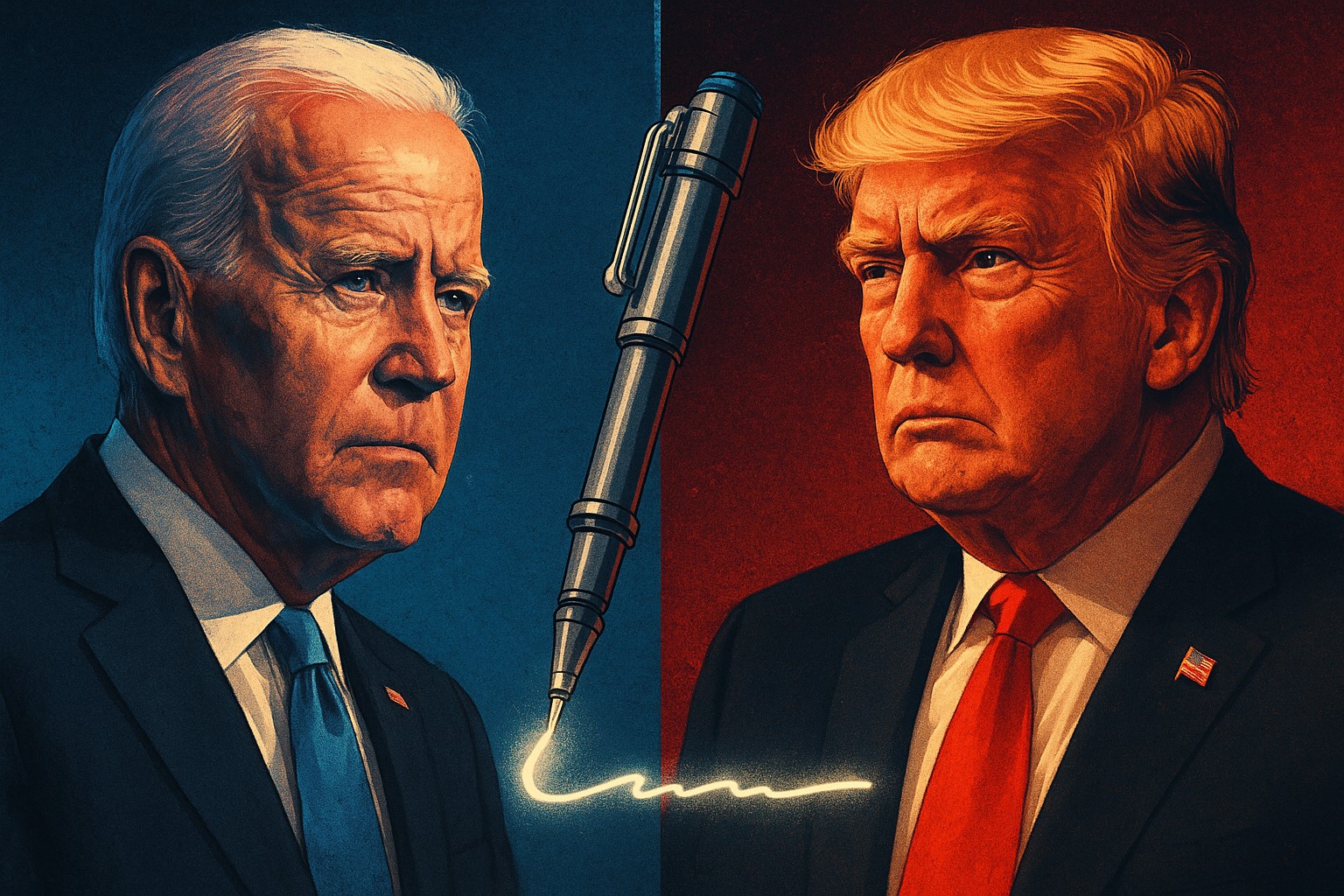
Presidential politics always generate noise, but the law underneath the noise is usually much quieter — and much clearer. On December 2, 2025, President Trump announced that he was “permanently terminating” every executive order, proclamation, pardon, and commutation from the Biden administration that bore an autopen signature. As always, this blog avoids the partisan food fight and focuses solely on what matters: the actual constitutional framework. The question isn’t whether Trump’s declaration is bold, clever, or outrageous. The question is whether it has any legal force. And on that point, the answer is remarkably straightforward.
What Trump Declared
On December 2, 2025, President Trump posted on Truth Social that he was “permanently terminat[ing]” all executive orders, pardons, commutations, proclamations, and similar documents from the Biden administration that were signed using an autopen — a mechanical device that reproduces a signature. He asserted that approximately 92% of Biden’s signed documents were “null and void” from inception because, according to him, the autopen was used without Biden’s specific authorization.
This message builds on Trump’s prior criticisms that Biden relied heavily on aides for routine signature work.
Are Autopen Signatures Legal?
In short: yes — and the law on this is not ambiguous.
- Longstanding Practice: Presidents have used mechanical signing devices since the early Republic. Modern autopen machines have been used by Eisenhower, Kennedy, Reagan, George W. Bush, Obama, Biden, and even Trump himself.
- OLC Guidance: A 2005 memo from the Department of Justice’s Office of Legal Counsel concluded that the president may constitutionally direct an autopen to sign bills into law. Article I, §7 requires presidential approval, not handwritten penmanship. This reasoning applies equally to executive orders, pardons, and proclamations.
- Presumption of Validity: Unless someone can prove the president did not authorize the document, the signature — autopen or not — is valid. There is no evidence supporting Trump’s claim that Biden’s autopen uses were unauthorized.
Every constitutional appellate lawyer analyzing the issue has said the same thing: the method of applying the ink does not determine the legality of the act.
Executive Orders Versus Pardons
The consequences of Trump’s claim differ depending on the type of presidential action.
Executive Orders & Administrative Documents
A president may revoke or amend a predecessor’s executive orders, but must do so through standard formal mechanisms. A social-media post has no legal significance. Even if Trump issued a formal executive order tomorrow, the argument that thousands of Biden-era actions were void ab initio due to autopen use would still have no constitutional foundation.
More than 160 Biden executive orders exist. Trump may replace or supersede some of them for policy reasons — but not by retroactively asserting they were never valid.
Pardons & Commutations
This is where Trump’s declaration most clearly collapses.
Article II, §2 grants the president the power to issue pardons and commutations. Once delivered, they are final — final against Congress, against the courts, and against future presidents. No successor president has ever revoked a prior president’s pardon. No statute authorizes it. Courts have never endorsed such a theory.
An autopen-approved pardon is still a pardon. Trump himself relied on autopen signatures during his first term without ever questioning their validity.
Constitutional Problems With Trump’s Claim
Trump’s declaration is unconstitutional for several independent reasons:
- Overreach of Article II Power: The Constitution does not allow a president to “un-sign” laws, pardons, or prior executive actions. Revocation must follow formal procedures, and some actions (like pardons) cannot be revoked at all.
- Separation of Powers: Declaring prior exercises of executive authority invalid without process intrudes on both Congress’s domain (where statutes were signed via autopen) and the judiciary’s role in determining legal validity.
- No Legal Effect: Presidential actions must be executed through lawful instruments — executive orders, proclamations, or published directives. Social-media posts have zero operative legal force.
Were this declaration formalized and challenged in court, it would almost certainly fail.
Conclusion
Trump’s autopen declaration is political messaging, not constitutional law. Biden’s autopen-signed actions remain legally valid unless overturned through standard, lawful mechanisms. The Constitution does not permit any president — past, present, or future — to retroactively erase another president’s signatures because they were applied by machine rather than by hand.
If Trump escalates this through formal action, the courts will likely resolve the dispute quickly. Until then, the legal status of Biden’s autopen-signed documents is not in doubt.
Image Credit: OpenAI DALL·E.