 Law Office of Jason Ostendorf LLC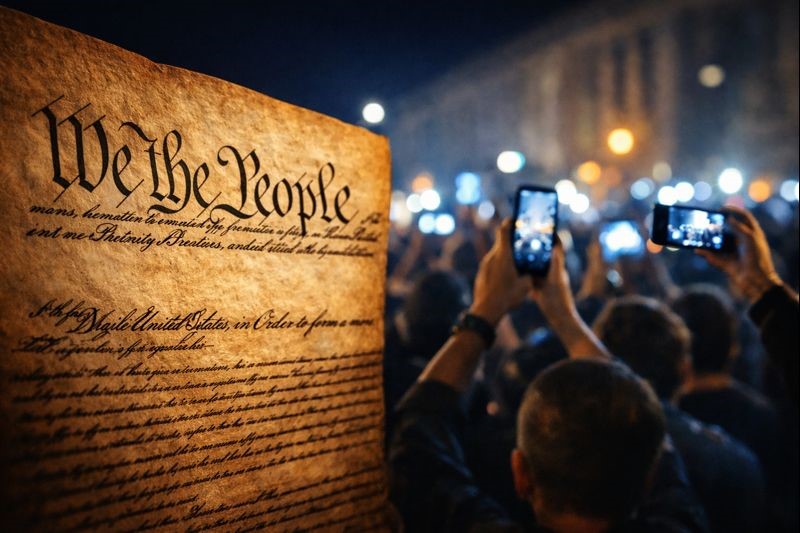
Every time a public controversy erupts—whether local or national—something predictable happens. Overnight, timelines fill with confident declarations about what the Constitution clearly says. People who have never opened the document, never read a judicial opinion, and never wrestled with competing interpretations suddenly speak with absolute certainty…
The confidence is striking. The speed is impressive. And the pattern is familiar.
This phenomenon isn’t new, and it isn’t really about constitutional law. It’s about how people think under pressure.
Emotion First, Interpretation Second
In moments of calm, the Constitution is abstract. It sits quietly in the background, invoked occasionally in civic ceremonies or high-school textbooks. But during a crisis, it becomes something else entirely: a weapon, a shield, a moral compass, and—most importantly—a source of certainty. When emotions spike, ambiguity becomes uncomfortable. The brain wants firm ground. Constitutional language, even when misunderstood or selectively quoted, provides it.
What’s often missed is the order of operations. The emotional reaction comes first. Outrage, fear, or indignation arises immediately, before any legal analysis occurs. Only afterward does interpretation enter the picture, not to discover meaning, but to justify the feeling that already exists. The result feels like principled reasoning. In reality, it’s rationalization wearing formal clothes.
This is why constitutional arguments during crises tend to sound so definitive. Nuance is not emotionally satisfying. Admitting uncertainty does nothing to calm anxiety or validate identity. Clear answers—especially ones framed as obvious or self-evident—do both. Invoking “the Constitution” signals seriousness and legitimacy, even when the substance underneath is thin.
The Constitution as Identity Armor
There’s also a social component. Constitutional language functions as identity armor. Saying “this is unconstitutional” doesn’t just express disagreement; it implies that the speaker occupies a higher moral and intellectual position. It converts a personal reaction into a universal principle. Disagreement then feels less like a difference of opinion and more like bad faith or ignorance.
Crises amplify this tendency because they strip people of control. When events feel chaotic, the law is expected to restore order—not procedurally, but emotionally. The Constitution becomes a stabilizing symbol, even though it was never designed to provide instant moral clarity. Its real function is slower, messier, and often unsatisfying. That reality is well known to judges, litigators, and appellate counsel who spend their professional lives navigating ambiguity rather than erasing it.
Why Crises Trigger Amateur “Scholarship”
The appeal of constitutional certainty is understandable. Being obviously right feels good. It reduces cognitive strain and creates in-groups and out-groups with clean boundaries. But it also distorts expectations about what law can do. Law does not exist to confirm instincts or reward righteous feelings. It exists to manage conflict through imperfect, human processes.
Seen this way, the sudden rise of amateur constitutional scholarship isn’t a failure of civic education so much as a feature of human psychology. When emotions run high, people reach for authoritative language to steady themselves. The Constitution is familiar, revered, and rhetorically powerful. It is an easy place to land.
What This Reveals About Law (and Us)
The deeper issue isn’t that people care about constitutional principles. It’s that we often ask the Constitution to perform psychological work it was never meant to do—to settle moral questions instantly, to validate emotional responses, and to eliminate uncertainty. When it fails to do that, frustration follows.
Understanding this doesn’t require cynicism. It only requires recognizing that law is a human system, not a moral oracle—and that our certainty during crises often says more about our need for stability than about constitutional meaning itself.
Image Credit: OpenAI DALL·E.