 Law Office of Jason Ostendorf LLC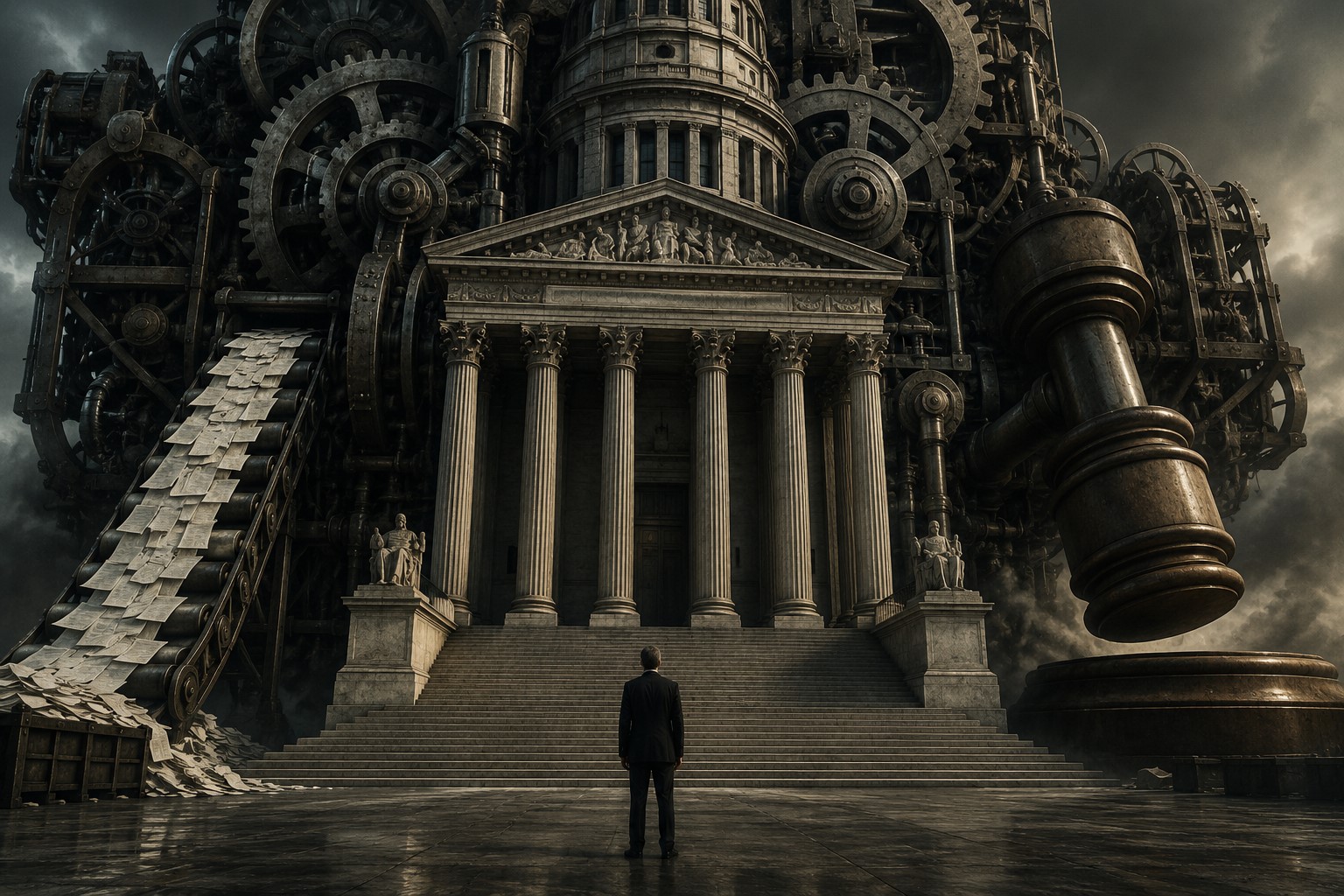
People like to imagine that authority and legitimacy are connected to correctness. We want to believe that the person with the power to decide is also the person who is right. That laws command obedience because they are just. That court decisions carry force because judges have carefully examined the facts, correctly applied the law, and reached the proper result.
Sometimes, all of those things are true. But they do not have to be.
A court order does not cease to exist because the judge got it wrong. A statute does not evaporate because it produces an unjust result. An appellate court does not lose the ability to issue its mandate because its reasoning was flawed. A government agency does not surrender its authority merely because the rule it is enforcing makes little sense.
Power does not require your agreement. It requires your compliance.
That distinction can be uncomfortable because we are conditioned to associate authority with some underlying justification for authority. Surely, we think, the system must be right—or at least mostly right—if it possesses the power to tell us what to do. But that gets the relationship backward. Power does not become power after proving itself correct.
Power is power because, when the argument is over, someone obeys.
The Law Makes This Easier to See
Law may provide one of the clearest demonstrations of the difference between correctness and authority. A trial judge can be wrong. Not arguably wrong. Not wrong merely because the losing party is unhappy. Actually wrong.
The judge can misunderstand the facts. Misapply controlling precedent. Exclude evidence that should have been admitted. Admit evidence that should have been excluded. Abuse discretion. Misinterpret a statute. Even violate the Constitution. And until something happens to change the result, the order is still the order.
This is one reason lawyers must understand the difference between believing a judge is wrong and behaving as though the judge has no authority. The former may provide grounds for reconsideration or appeal. The latter can provide grounds for contempt. Those are very different things.
There are strategic ways to approach a difficult court, including understanding that much of courtroom advocacy is performance and perception. I have written separately about hostile judges. But even the most skilled advocate eventually confronts the same institutional reality: unless a ruling is stayed, reversed, vacated, or otherwise displaced, disagreement alone does not neutralize it.
Correctness and enforceability are separate concepts. The law hopes they overlap. Power does not depend upon it.
We Confuse Legitimacy With Morality
Part of the confusion comes from the way human beings think about law itself. We are taught from childhood that laws are rules, that rules exist for reasons, and that following the rules is generally associated with being good. Over time, those ideas can quietly merge into something much broader: the assumption that what is legal is probably moral, and that what is officially decided is probably right.
It is an understandable assumption. It is also historically indefensible.
Law and morality overlap, but they are not the same thing. I have discussed elsewhere why our tendency to assume that law is moral can be misleading. The more unsettling point here is that a legal system could not function if every exercise of authority depended upon each affected person’s independent moral approval.
Imagine if every losing litigant could decide whether a judgment was sufficiently fair to deserve obedience. Imagine if every citizen could individually determine which statutes possessed enough moral legitimacy to count as law. Imagine if every court order remained optional until the person subject to it became intellectually persuaded that the judge had reached the correct result.
That would not be a legal system. It would be a debate club.
So institutions substitute something operational for universal agreement: procedure. The question eventually stops being, “Who is actually right?” It becomes, “Who has the authority to decide?”
Eventually, Someone Gets the Last Word
This may be one of the least appreciated functions of a legal system. We speak constantly about justice. Fairness. Due process. Rights. Truth. And those things matter enormously. But a functioning legal system has another requirement that is far less romantic.
Disputes have to end.
Someone must decide who gets the property. Whether money is owed. Where a child will live. Whether a contract was breached. Whether a defendant is guilty. Whether an agency exceeded its authority.
We create trial courts to decide. Then, because trial courts can be wrong, we create appellate courts to review them. Sometimes we create another appellate court above that one. But the ladder cannot extend forever. At some point, someone gets the last word—even when the last word is wrong.
This is not necessarily evidence of corruption or institutional failure. It is a structural necessity. A civilization in which every dispute remains permanently open for reconsideration would eventually become incapable of deciding anything at all.
Finality therefore possesses a strange power. It can transform a proposition that remains intellectually debatable into an outcome that is institutionally settled. The losing party may continue believing the decision was wrong. The losing party may even be correct.
The machinery continues anyway.
No Villains Are Required
When systems produce outcomes we perceive as unjust, human beings instinctively search for villains.
- The corrupt judge.
- The dishonest lawyer.
- The heartless bureaucrat.
- The greedy corporation.
- The malicious government official.
Sometimes those people exist. Human beings are perfectly capable of corruption, dishonesty, greed, cruelty, and abuse. But here is the more disturbing possibility: Sometimes nobody is evil.
A system can produce an awful result while every person inside it believes he or she is simply doing a job. The lawyer advances the client’s position. The opposing lawyer advances the other position. The judge applies the rules as the judge, perhaps, understands them. The clerk processes the order. The sheriff enforces it.
Everyone can be polite. Everyone can go home that evening believing they behaved professionally. And someone can still be destroyed.
Systems do not require malice to produce suffering…
That observation is important because outrage often depends upon finding someone to blame. We assume that a terrible outcome must have been caused by a terrible person. When we cannot locate one, we invent one. We assign motives. We imagine conspiracies. We personalize what may actually be structural.
But systems can be far more powerful than the individuals operating them. The machine does not need anyone to hate you.
Outrage Often Misunderstands the Machine
When an institution behaves unfairly, people often react as though something impossible has occurred.
“They can’t do that.” … Sometimes they can. “But that isn’t fair.” … Maybe not. “But I’m right.” … You might be.
None of those statements necessarily answers the question that matters most in that moment: What happens next?
This is where outrage, however understandable, can become strategically useless. Outrage focuses on what the system should have done. Effective action requires understanding what the system did, what power it possesses, and what mechanisms—if any—exist to challenge the result.
A person screaming that a court order is unfair may be morally correct. But a lawyer filing the right motion before the right deadline is more likely to accomplish something.
Power is rarely impressed by indignation. It responds to mechanisms.
Systems Over Souls
There is a tendency to speak about institutions as though they were conscious beings.
- “The government wants.”
- “The court believes.”
- “The system decided.”
But systems do not possess minds. They are accumulated structures of rules, incentives, procedures, habits, precedents, and human behavior.
No single person designed the legal system as it exists today. It evolved across centuries. Rules accumulated. Institutions formed. Precedents constrained later decisions. New procedures were layered over old ones. People entered structures that already existed and learned to operate within them.
The judge did not invent judging. The bureaucrat did not invent bureaucracy. The citizen did not invent obedience. Everyone arrived inside machinery that was already moving.
Viewed through a deterministic lens, even the exercise of authority becomes less personal. Each participant acts from a position created by everything that came before: biology, upbringing, education, incentives, institutional culture, precedent, circumstance, and the immediate causes acting upon that person at that moment.
The result does not require a mastermind. It does not require a conspiracy. It does not require a villain.
Cause follows cause. The machine moves.
The Most Powerful Authority Barely Looks Like Force
Perhaps the most remarkable thing about power is how rarely mature systems need to display it directly. Most people obey court orders without a police officer standing beside them. Most employers honor garnishments without armed agents arriving at the payroll department.
Banks freeze accounts because documents arrive through recognized channels. Clerks issue writs because judges sign orders. Sheriffs enforce judgments because courts issue writs. Other institutions recognize those actions because the system tells them to.
The power exists not merely in one person or one institution, but in a network of coordinated behavior. Everyone behaves as though the authority is real. And therefore, functionally, it is.
This is why the strongest power often does not look violent. It looks administrative. A form is filed. A deadline passes. An order is entered. A database is updated. A bank account changes. A door locks.
Power is strongest when nobody needs to draw a weapon at all.
Power Does Not Need to Win the Argument
None of this means injustice should be accepted. We should want institutions to be fair. We should challenge erroneous decisions through the mechanisms available to us. Lawyers should appeal reversible errors. Citizens should advocate for better laws. Judges should strive to get cases right.
Power should be questioned precisely because power can be wrong. But questioning power effectively requires first understanding what it is.
A court does not need to persuade you that its judgment is correct. A government does not need to win a philosophical debate before enforcing a statute. A bureaucracy does not need to hate you before it harms you. A system does not need a villain.
And power does not need to be just. It does not even need to be right.
It only needs the machinery around you to continue moving when you say no.
Image Credit: OpenAI DALL·E.
The Outsider Penalty: When Judicial Comfort Matters More Than Truth