 Law Office of Jason Ostendorf LLC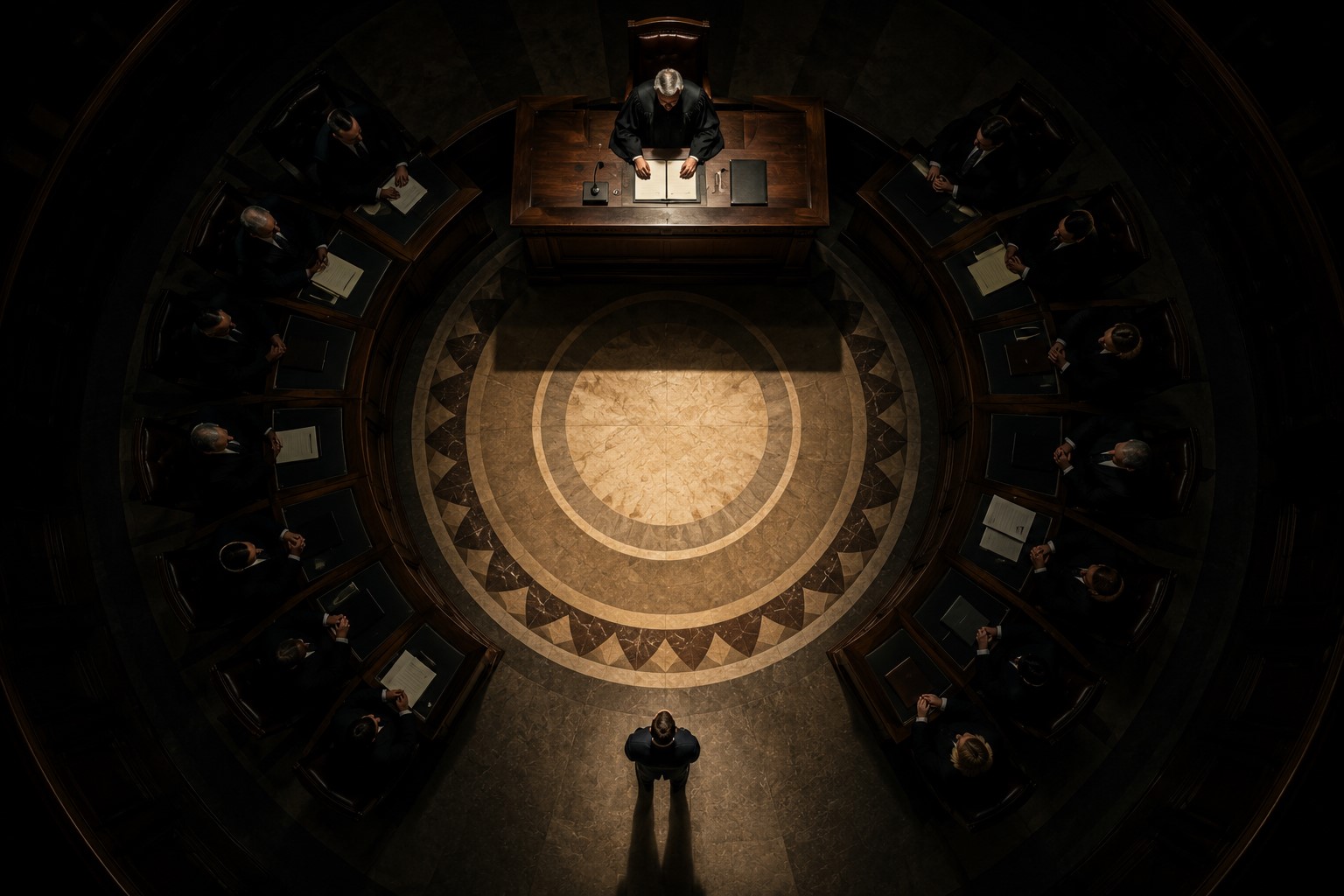
We tell ourselves a comforting story about judges. We imagine that once the robe goes on, the human being somehow comes off. The architecture of every courtroom reinforces the illusion: elevated benches, black robes, formal titles, ritualized language, and the command to rise when the judge enters. Every detail quietly suggests that ordinary human judgment has been replaced by something purer—objective reason embodied in an institution.
It is a reassuring idea. It is also almost certainly wrong.
Judges remain human beings. They possess the same evolutionary hardware as everyone else. They experience familiarity, irritation, trust, status, first impressions, confirmation bias, in-group preference, halo effects, and the countless cognitive shortcuts that modern psychology has spent decades documenting. A judicial appointment changes one’s authority; it does not rewrite hundreds of thousands of years of human evolution.
That observation should not be mistaken for an accusation. Most judges work diligently to decide cases fairly, conscientiously, and according to law. The point is both simpler and more unsettling: sincerity does not eliminate subconscious bias. Human beings rarely experience their own cognitive shortcuts as bias. We experience them as judgment.
The legal system has always understood this at some level. Rules of evidence, written opinions, standards of review, appellate courts, and procedural safeguards exist because human judgment is imperfect. The rule of law was never designed for angels. It was designed for people.
Perhaps nowhere is that reality easier to observe than in the treatment of the outsider.
Every Courthouse Has Its Own Tribe
Spend enough time in any courthouse and something becomes apparent that no rulebook mentions: every courthouse develops its own culture. No one needs to design it. Human beings organize themselves into groups wherever they gather, and every enduring group eventually develops its own language, customs, expectations, hierarchies, and unwritten rules governing who belongs.
The legal profession is no exception. Certain lawyers become familiar faces. Certain personalities become associated with professionalism. Certain styles of advocacy are accepted as reasonable before the merits of a particular argument are considered. Over years—sometimes decades—a quiet social ecosystem emerges. Lawyers learn how much deference particular judges prefer, when humor will be welcomed, which objections invite irritation, and which arguments are regarded as making everyone’s day unnecessarily difficult.
Most adapt. That is not a moral failing. Adaptation is one of humanity’s oldest survival strategies. We naturally learn the customs of groups upon which our success depends, adjusting our language, behavior, and sometimes even our opinions because belonging has always carried advantages.
There is substantial value in this institutional knowledge. Efficient courts require prepared, competent, and civil advocates. No legal system could function if every hearing became an exercise in theatrical conflict. Experienced lawyers often know which disputes matter, which concessions cost nothing, and which arguments can be presented more effectively without unnecessary friction.
But efficiency has a psychological side effect. The lawyer who consistently reduces friction begins to feel familiar. Familiarity becomes predictability. Predictability becomes trust. Trust quietly becomes credibility. None of those transitions requires conscious favoritism, yet together they shape the environment in which future arguments are received.
Then there is the outsider: the lawyer who insists upon constitutional protections even when they inconvenience the docket; who refuses to abandon an argument merely because “that’s how we’ve always done it”; who values preserving the record more than preserving courtroom comfort; and who is willing to create tension when tension is the unavoidable consequence of faithful advocacy.
Every institution claims to value independent thought. Very few enjoy experiencing it.
Judicial Comfort Is Not Corruption
Discussions of institutional favoritism often collapse too quickly into allegations of corruption. That is understandable because corruption is easy to recognize and easy to condemn. Bribery, deliberate favoritism, dishonesty, and conscious abuse of authority are ethical failures. Most judges would reject them without hesitation.
The more difficult question is what happens when everyone involved is acting in complete good faith.
Modern psychology has repeatedly demonstrated that people extend greater trust to those who appear familiar, competent, cooperative, and socially aligned with existing expectations. We mistake confidence for accuracy, status for expertise, and familiarity for credibility. These are not uniquely judicial shortcomings. They are human ones. Judges simply exercise ordinary human judgment from one of society’s most consequential positions of authority.
Imagine two lawyers making precisely the same argument, relying upon the same authorities, citing the same record, and seeking the same legal conclusion. One has appeared before the court for twenty years and is regarded as sensible, cooperative, and reliable. The other has developed a reputation for challenging convention whenever he believes the law requires it.
The facts have not changed. The law has not changed. Only the advocate has changed.
Few judges consciously think, “I trust this lawyer because I know him,” or, “I distrust this lawyer because he refuses to conform.” Human cognition is more subtle. The mind fills gaps with prior experience. Familiar advocates require less cognitive effort. They are easier to predict, and predictability naturally produces confidence. By the time deliberate legal analysis begins, the psychological terrain may already have been prepared.
Behavioral scientists describe these tendencies through concepts such as confirmation bias, motivated reasoning, in-group preference, and the halo effect. Lawyers often give them a different name: experience.
That difference in vocabulary matters. Once subconscious preference is relabeled as professional judgment, it becomes extraordinarily difficult to recognize. The institution experiences its conclusions not as preference, but as “wisdom”… accumulated over years of practice.
Sometimes it is wisdom. Sometimes it is familiarity wearing wisdom’s clothes.
The Outsider Penalty
None of this proves that outsiders are systematically treated unfairly. It does suggest something important: they begin from a different psychological starting point.
Long before the first witness testifies, the first objection is raised, or the first appellate brief is filed, the human mind has begun answering questions that are not strictly legal. Is this lawyer competent? Trustworthy? Respectful? Does this lawyer understand how things are done here? Is this person likely to create unnecessary problems?
Those questions are usually answered instinctively. Reputation, familiarity, speech, appearance, confidence, prior interactions, and shared professional identity all contribute. The legal analysis may not yet have begun, but the advocate has already been placed within a psychological framework.
Human beings routinely mistake familiarity for credibility. Physicians are more readily trusted when they fit our expectations of competence. Professors receive greater deference when they resemble our mental image of authority. Executives inspire confidence when they project decisiveness. Politicians are often judged less by the quality of their reasoning than by whether they reinforce beliefs their audience already holds.
Courts are not immune simply because their mission is justice. If anything, the extraordinary responsibility entrusted to judges makes understanding these tendencies more important.
This is why outsiders matter. An outsider does not create an institution’s psychology; the outsider reveals it. Inject dye into an artery and the artery becomes visible. The dye did not create the circulatory system. It exposed what was already there. Outsider advocates perform a similar function when they question assumptions so familiar that the institution no longer recognizes them as assumptions.
Why is this procedure followed? Why is this argument considered unreasonable? Why is one lawyer quietly respected while another is dismissed? Why does an unconventional argument feel wrong before anyone has explained why it is legally wrong?
Institutions rarely enjoy such questions, not because they are dishonest, but because stable systems naturally protect their own stability.
When Professionalism Becomes Performance
Few words command greater respect within the legal profession than professionalism. Properly understood, professionalism deserves that respect. Honesty, preparation, competence, civility, diligence, and respect for both the court and opposing counsel are indispensable to the administration of justice.
The difficulty begins when professionalism quietly expands beyond ethics and competence to include emotional predictability. Institutions naturally reward lawyers who communicate in familiar ways, raise familiar arguments, and challenge authority within familiar boundaries. Nothing about this process is sinister. It simply makes institutional life easier.
Yet ease and truth are not synonymous.
A criminal defense lawyer who insists upon every constitutional safeguard may become known as someone who “slows everything down.” A civil litigator unwilling to overlook procedural shortcuts may acquire a reputation for making routine litigation unnecessarily complicated. An appellate lawyer who repeatedly questions settled assumptions may be viewed as someone who is always searching for another issue.
Notice what those descriptions omit. They do not tell us whether the lawyer is correct. They describe how the lawyer makes the institution feel.
Institutions often mistake the absence of discomfort for the presence of professionalism. Once that happens, a subtle inversion occurs. Lawyers no longer adapt merely to become more effective advocates. They begin adapting to become psychologically reassuring. Most make that adjustment without realizing it. Like every social species, human beings learn which behaviors produce acceptance and which produce resistance.
The danger is not that lawyers become courteous. The danger is that they begin confusing institutional approval with faithful advocacy.
Gerry Spence spent much of his career warning against precisely this temptation. Whether one agrees with every aspect of his philosophy is beside the point. His central psychological observation remains persuasive: lawyers who spend enough years seeking the institution’s approval may eventually forget that their duty is to challenge power when the law requires it, not merely to navigate power skillfully.
That is the outsider’s paradox. The qualities that make an advocate most valuable to a difficult client are often the same qualities that make the advocate least comfortable for the institution itself.
Who Becomes the Judge?
This dynamic raises an uncomfortable question the profession seldom asks aloud: who becomes a judge?
The answer is not random. Judges are ordinarily selected from the ranks of experienced lawyers. The mechanism varies—appointment, election, nominating commission, political process—but the underlying reality is consistent. Institutions participate in selecting their own future stewards.
That observation is neither cynical nor uniquely legal. Universities select professors who embody the institution’s understanding of scholarship. Military organizations promote officers who reflect their conception of leadership. Corporations elevate executives who reinforce the culture they wish to preserve. Every enduring institution gradually reproduces itself.
Legal institutions are no exception. They tend to elevate lawyers who are respected within the existing culture, who have demonstrated institutional fluency, and who fit prevailing expectations of judicial temperament. Those qualities may correlate strongly with integrity, intelligence, patience, and sound judgment. But, they may also simply correlate with comfort.
Institutions rarely elevate the lawyers who most consistently force them to confront uncomfortable truths. They more often elevate the lawyers who make the institution feel most like itself.
That does not mean judges lack independence or courage. It means institutions preserve more than formal rules. They preserve habits, assumptions, traditions, and shared understandings of what professionalism looks like. Yesterday’s familiar lawyer becomes today’s respected judge. Today’s respected judge influences tomorrow’s young lawyers. Tomorrow’s young lawyers become the pool from which the next generation of judges is selected.
No conspiracy is required. Only cause and effect.
The Good Old Boy System Without Good Old Boys
Whenever favoritism within the legal profession is discussed, the imagination gravitates toward smoke-filled rooms, whispered agreements, political favors, and insiders deliberately protecting one another. Sometimes such corruption exists. Human history leaves little room to deny that. But corruption is also the easiest explanation because it gives us villains, motives, and a satisfying narrative.
Reality is usually less dramatic and, in some respects, more unsettling.
The most powerful institutional preferences often emerge without anyone consciously creating them. Shared experience produces shared expectations. Shared expectations become culture. Culture begins reinforcing itself.
Every courthouse develops lawyers who are regarded as “reasonable.” Every courthouse develops lawyers known for “causing problems.” Those reputations are rarely built from a single case. They emerge gradually through hearings, conversations, staff impressions, professional gossip, and years of accumulated experience. Eventually, the reputation begins to exist independently of the conduct that created it.
That is how institutions develop memory. Young lawyers inherit those memories without realizing it. Court staff reinforce them through casual conversation. Experienced attorneys explain who “the good lawyers” are, which judges appreciate certain styles of advocacy, and which lawyers are “always filing something.” None of this requires a coordinated effort. The culture becomes its own gatekeeper.
Confirmation bias then performs the remaining work. The lawyer already considered thoughtful receives the benefit of the doubt when making an unusual argument. The lawyer already considered difficult may present the same argument and encounter greater skepticism. Each new interaction is interpreted through the existing narrative, while contrary evidence is treated as an exception.
The system does not need good old boys in a back room. It needs only enough people sharing similar assumptions for long enough that those assumptions begin to feel like objective reality.
Law and the Human Mind
The suggestion that judges remain subject to ordinary human psychology is neither modern nor radical. Nearly a century ago, Judge Jerome Frank challenged the comforting fiction that judicial decisions emerge from a mechanical application of legal rules. In Law and the Modern Mind, Frank argued that judges inevitably bring their experiences, personalities, intuitions, and subconscious assumptions to the bench. Law constrains those influences; it does not erase them.
The idea unsettled much of the legal establishment because it threatened a deeply reassuring belief: that legal outcomes could be understood as products of objective reasoning alone. Frank proposed something more realistic. Wherever human judgment exists, psychology follows.
Modern neuroscience has strengthened that conclusion. The brain does not passively record reality. It actively constructs it, filtering enormous amounts of information, emphasizing some details, overlooking others, identifying patterns, filling gaps, and generating coherent narratives from incomplete evidence. These shortcuts evolved because they improved survival, not because they guaranteed objective perception.
Judges possess extensive legal training. They do not possess different brains.
That observation should inspire humility rather than cynicism. The rule of law was not designed upon the assumption that judges would become perfectly objective. It was designed upon the recognition that they would not. Rules of evidence, written opinions, appellate review, procedural safeguards, and ethical obligations exist because human judgment becomes more reliable when it is structured, transparent, and accountable.
The Ritual of Authority
If judges remain fully human, why do people so readily imagine otherwise? Part of the answer lies in ritual.
Long before constitutions or modern governments, human societies developed rituals surrounding authority. Chiefs wore distinctive clothing. Priests occupied elevated platforms. Kings sat upon thrones. Subjects bowed. Ritual communicated legitimacy before anyone spoke.
Modern courtrooms inherited much of that tradition. The judge sits above everyone else. Participants rise when the court enters. Formal titles replace ordinary names. Robes conceal individuality beneath office. These customs serve legitimate purposes. They reinforce respect for law rather than personality and remind litigants that disputes are resolved through institutions instead of force.
But ritual is also psychologically persuasive. The more elaborate the ritual, the easier it becomes to forget the humanity beneath it. We begin speaking as though “the Court” possesses thoughts and intentions independent of the individual occupying the bench. Opinions acquire an institutional voice that obscures the fact that every decision was written, approved, and interpreted by human beings.
Dissents provide the clearest reminder. Intelligent, conscientious judges routinely examine the same record, apply the same precedents, and reach profoundly different conclusions. Those disagreements do not prove the system has failed. They prove that judging involves judgment.
The robe does not eliminate humanity. It makes it easier for everyone else to forget it is there.
Why Appellate Courts Matter
If familiarity and institutional culture exert such quiet influence, the legal system must create distance between immediate perception and final authority. That is one of the central purposes of appellate review.
Appellate courts do not exist because trial judges are expected to perform poorly. They exist because every system of justice benefits from distance. Time softens emotion. A written record replaces memory. Legal reasoning receives greater attention than courtroom dynamics. The personalities occupying the courtroom recede, allowing the governing principles to move closer to center stage.
Appellate judges remain human and belong to institutions with cultures of their own. Appellate review is therefore no guarantee of objectivity. It is, however, one of civilization’s most thoughtful efforts to reduce the influence of instinct. Written briefs, defined standards of review, multi-judge panels, oral argument, and reasoned opinions insert friction between perception and power.
In that setting, friction is a virtue. It slows judgment enough to permit reflection.
This is why appellate advocacy differs fundamentally from trial advocacy. Trial lawyers persuade amid unfolding testimony, evidentiary rulings, scheduling constraints, and the unavoidable pressures of managing a courtroom. Appellate lawyers inherit a fixed record and ask judges to reconsider what happened through a more disciplined lens. Their task is not merely to identify error, but to expose assumptions that may have felt natural in the moment and appear less defensible once written down.
No appellate court can escape institutional psychology. But distance matters. Deliberation matters. Written reasoning matters. Every safeguard that encourages reflection over intuition moves the system closer to its governing ideal: that outcomes should depend more upon law than upon the psychological comfort of the moment.
The Necessary Outsider
If institutions naturally reward familiarity, the easiest response is cynicism. The outsider may conclude that justice is unattainable and withdraw. History argues otherwise.
The legal tradition has rarely advanced because institutions spontaneously questioned themselves. It has advanced because lawyers, litigants, and judges occasionally challenged assumptions everyone else regarded as obvious. Arguments once dismissed as disruptive, impractical, or radical later became settled doctrine. Institutions often celebrate in hindsight the same advocates they resisted in real time.
Progress rarely begins with consensus. Consensus usually follows progress.
The outsider penalty therefore never disappears. It migrates to whoever asks the next uncomfortable question.
Recognizing this dynamic imposes obligations upon judges and lawyers alike. Judges must cultivate intellectual humility—not because they lack intelligence, but because intelligence offers no immunity from human cognition. The argument that initially feels irritating may be exposing an assumption no one has examined in years. A useful question is not merely, “Is this argument wrong?” but also, “Why does this argument feel wrong?” The answers are not always the same.
Lawyers shoulder an equally demanding burden. Respect for the court, opposing counsel, and the rule of law is indispensable. None of those virtues requires surrendering independent judgment. The advocate’s obligation is not to preserve institutional comfort. It is to preserve the client’s rights. Sometimes those duties align perfectly. When they do not, faithful advocacy may require choosing the client over the institution.
That choice should not be confused with disrespect. An advocate willing to raise difficult arguments demonstrates confidence that the judiciary is strong enough to confront them. The lawyer who remains silent merely to avoid discomfort pays the institution a lesser compliment. He assumes it cannot withstand meaningful challenge.
The Human Institution
The courthouse is only one illustration of a broader phenomenon. Universities reward scholars who embody prevailing academic culture. Corporations elevate executives who reflect their understanding of leadership. Political parties promote candidates who reassure existing coalitions. Military organizations cultivate officers who preserve institutional values. Families develop unwritten rules governing loyalty, success, and belonging.
Every enduring institution develops a personality because every enduring institution is composed of human beings. The outsider exists within all of them, and so does the outsider penalty.
Institutions are not inherently unjust. They make civilization possible by preserving knowledge, coordinating cooperation among strangers, resolving disputes peacefully, and accomplishing tasks no collection of isolated individuals could achieve. But institutions inevitably inherit both the strengths and limitations of the species that created them.
Human beings evolved to survive, not to perceive reality with perfect objectivity. We prefer familiarity to uncertainty, consensus to conflict, and explanations that reinforce our existing understanding over those that require rebuilding it. Those instincts helped our ancestors cooperate, identify threats, and preserve social cohesion. The pursuit of truth often requires resisting them.
Perhaps that is the rule of law’s greatest achievement. It does not assume human beings are objective. It assumes they are not. Constitutions, procedural safeguards, written opinions, burdens of proof, ethical obligations, and appellate review represent civilization’s continuing attempt to restrain the weaknesses of the human mind through reasoned process rather than unquestioned power.
That project is necessarily unfinished. Judges will remain human. Lawyers will remain human. Litigants will remain human. Their institutions will reflect both their wisdom and their limitations.
The lesson is not suspicion. It is humility: the recognition that confidence and correctness are not always the same thing; that disagreement is not necessarily disrespect; that novelty is not error; and that discomfort is not falsehood.
The healthiest institutions are not those that eliminate disagreement. They are those that remain capable of learning from it. The outsider performs an indispensable service by asking questions the institution has gradually forgotten to ask. Sometimes those questions are misguided. Sometimes they expose the assumptions everyone else has mistaken for truth. The institution cannot know which is which if unfamiliarity itself has already become grounds for dismissal.
The true measure of an institution is not how confidently it speaks, but how willingly it listens.
The outsider’s greatest obstacle is rarely proving that he is right. It is persuading the institution that being right matters more than feeling comfortable.
Image Credit: OpenAI DALL·E.
Power Doesn’t Need to Be Just or Correct—It Just Needs to Be Obeyed
How to Deal with a Hostile Judge: Remember, It’s Theatre